Most team-hat orders go wrong before a single stitch is sewn, in the choices made on the order form. A bowling league or team cap has to fit a roster of different heads, carry a name or logo cleanly, and look consistent in a group photo, and the decisions that decide all three, size system, closure, panel count, and crown structure, are easy to get wrong because they are invisible until the box arrives. These are the fit and construction mistakes that turn a bulk cap order into a pile of returns, and how to avoid each one.
Mistake 1: Assuming one size fits the whole roster
An adjustable one-size cap is the default for teams, and for good reason, but “one size fits most” is not “one size fits all.” Published guidance puts the comfortable range of a typical adjustable cap at roughly 21.5 to 23.5 inches of head circumference, which covers most adults but leaves out smaller youth heads and the larger end of adult sizing. The chart below shows how the common fit systems stack up against the typical adult range. Notice that a single stretch-fit band does not span the whole adult population either; brands split stretch-fit into S/M and L/XL for exactly that reason.
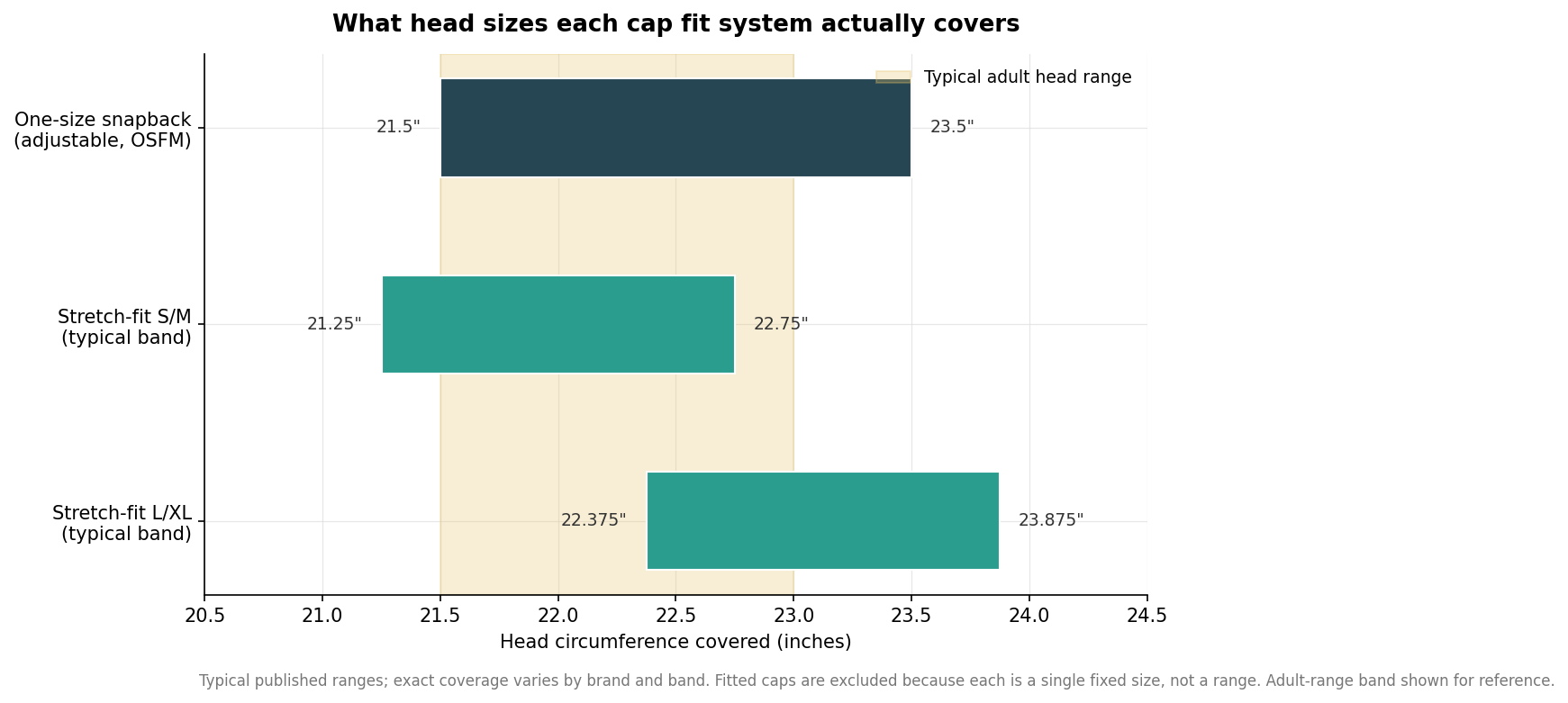
The practical fix is to match the fit system to the spread of your group. A recreational league of adults is well served by an adjustable snapback or strapback. A team that includes juniors, or one with a wide range of head sizes, is often better off with a cap offered in lettered sizes; stock blanks like the Valucap VC300A and Sportsman 2050 come in a graded run from about XS to 4XL, which lets you size individuals rather than hope one band stretches far enough.
Mistake 2: Picking a closure before you know how you’ll hand them out
The closure decides both fit and logistics, so choose it around distribution, not looks alone. A plastic snapback adjusts across the widest range and lets you order a single size for everyone, which is why the classic trucker blank, the Richardson 112 style, is the workhorse of team caps; the trade-off is a firmer band some people find less comfortable for long wear. A strapback or hook-and-loop closure gives a cleaner back and fine adjustment but a slightly narrower range. A stretch, or flex, fit is the most comfortable and holds shape well, but you must order the right band size per person, and it will not stretch indefinitely. A true fitted cap looks the sharpest and has no adjuster at all, which means every hat has to be sized to an individual head. If you are shipping caps to people you cannot measure, an adjustable closure removes the sizing risk; if everyone is in the room, a fitted or flex option can look better.
Mistake 3: Ignoring the front seam when you have a wide logo
Front decoration and panel count are linked, and a wide team wordmark can collide with a center seam. A six-panel cap, the traditional baseball shape, has two front panels split by a seam down the middle, which produces a rounded, contoured crown but interrupts the front canvas; a logo has to be sized to sit within one side or kept small enough to bridge the seam cleanly. A five-panel cap uses a single seamless front panel, giving a flatter profile and a large, clean area that suits a bold front logo or a wide league name. Stock lines make both easy to source; OTTO’s catalog, for instance, includes five-panel mid-profile and six-panel low-profile blanks in the same color families. Decide the artwork and the panel count together, because a design drawn for a clean five-panel front will not drop onto a seamed six-panel without compromises.
Mistake 4: Overlooking crown structure and profile
Two caps with identical circumference can still look and wear completely differently depending on structure and profile. A structured crown uses stiffening (buckram) behind the front panels so the cap stands up on its own, holds a tall embroidery cleanly, and reads as a classic ball cap. An unstructured crown, the soft “dad hat” build, sits lower and collapses against the head for a relaxed look, but it gives less height for a large front logo and shows stitching tension more. Profile compounds this: a high or mid profile leaves room for a taller design, while a low profile, popular and modern, can crowd a logo that was sized for a taller crown. Before you commit, confirm that your embroidery or patch height fits the crown you chose, and that the structure matches the look the team wants, whether that is the crisp stand-up front of a structured six-panel or the low, soft sit of an unstructured strapback.
Mistake 5: Ordering fitted caps without measuring
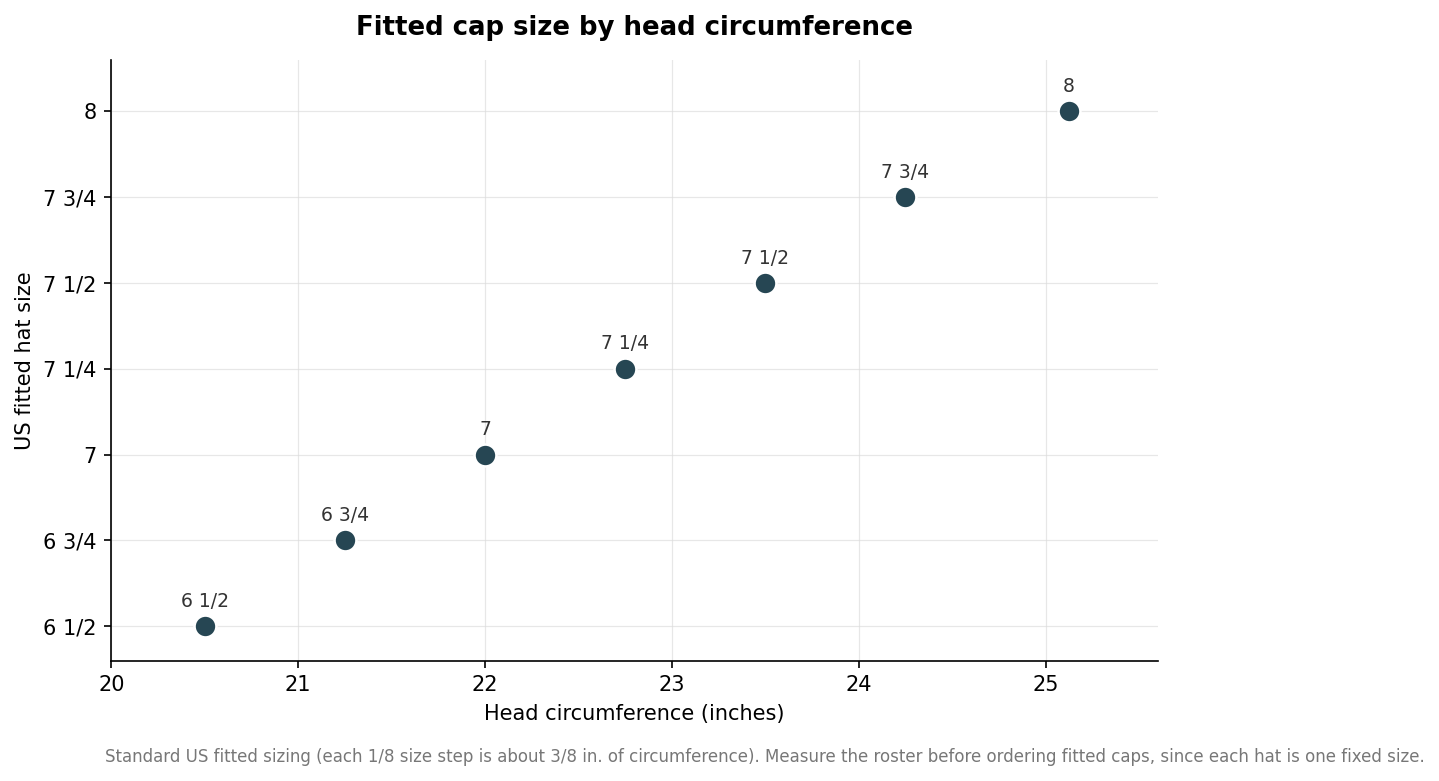
If you go with fitted caps for their clean look, the one non-negotiable step is measuring the roster first. Fitted sizing is standardized: each one-eighth size step corresponds to roughly three-eighths of an inch of head circumference, so a 22-inch head is about a size 7 and a 22.75-inch head about a 7 1/4, as the chart below lays out. Guessing fitted sizes from an average is how orders end up unwearable, because the typical adult range spans several sizes and individuals vary widely within it. Collect a simple circumference measurement from each person with a soft tape around the forehead, convert it with a standard chart, and order to those sizes.
None of these mistakes is expensive to avoid; each one costs only a little attention at the order stage. Match the size system to the spread of your roster, pick the closure around how you will distribute the caps, align the panel count and crown with your artwork, and measure before you buy anything fitted. Get those four right and a single cap design will fit the whole team, wear comfortably through a season of league nights, and look like it belongs together in every photo.